
Most coaches have forgotten how hard the first month is. You do not need to teach someone how to walk. You do need to teach a duck dive, a clear snorkel, and how to sit flat. Those skills are in Basic Water Skills. This page is about how to run the teaching so the skills stick.
Build from the bottom
Fitness to reach the bottom, then individual skill, then tactics. A team tactic is a way to get the puck and a way to use it once you have it. Both fail if nobody can pass, tackle, or stay down long enough to see a teammate.
Keep touching every layer. A whole month of only BOGDATs, or only positions, loses people. Ask why the group plays. Enjoyment is the usual answer, and games are where they feel it.
How to teach a skill
Show it, name the one or two feelings that matter (knees on the bottom, fins in the water before you kick, blow on the way up), and let them try it the same session. End the block when the habit is repeatable, even if it is slow.
Partner people up. Beginners struggle to anticipate the puck and to get down on time. A partner they are told to find, and to drop with, gives them a person to look for. In a 3-3 that partner is the other forward or the supporting back. The idea is the same one this guide uses everywhere: someone on the puck, someone in support.
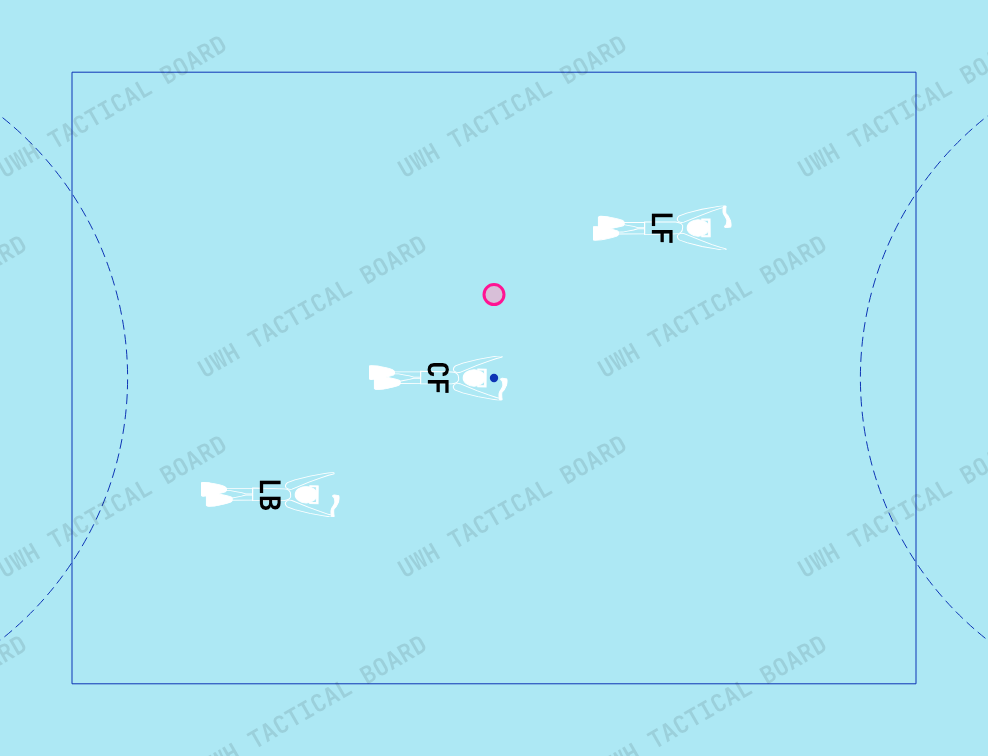
Walk formations on the deck or in a gym before you talk through them underwater. Players learn spacing with their feet faster than from a paragraph. Diagrams help after they have stood in the shape.
Rules that survive any formation
These apply in the 3-3 this guide teaches, and in any other shape a coach later chooses:
- Do your own job.
- If you make a mistake, fix it yourself before you look for someone else to.
- Pass before you get stuck with the puck.
- Stay down long enough to see the pass arrive.
- When you do not have the puck, watch the puck.
What “fit enough” means here
Two kinds of fitness show up every game. Surface fitness is how you travel between drops, especially on a full court. Underwater fitness is bottom time: repeated short holds, not one heroic one. Skill does not carry an unfit team against a fit one, because a player who is up recovering cannot tackle, pass, or fill a gap. Field sports still let a tired player kick the ball. Hockey does not.
Who tends to play where
This guide’s positions chapter already defines the jobs. A coaching note from school teams: new players often start at forward because the backs are feeding them the puck, so they can learn by receiving. Fast players with a high work rate and an appetite to score stay there. Backs need turns, a pass, and the nerve to get the puck back. Mids need to be able to be down when the link is needed, and to look up while the stick stays on the puck. See Positions.
Further reading
WUHA Schools Coaching Manual (Wellington Underwater Hockey Association). Sections 1–2, 6, and 9 are the source for the teaching order and team rules above.